
2026 3rd Quarter Market Commentary
Top Headline for Q3: Persistent Inflation Hurts Fixed Income
For the first time in a long time, investors appear to be fearful about inflation. While high inflation has, thus far, largely been ignored by investors, bondholders now appear to be aggressively selling. Perhaps the most followed bond benchmark in the world is the yield on the 10-year U.S. Treasury bond. As you can see in the chart below, the “Market Yield” (income over price) shot straight up during the quarter reaching 5.29% - a level not seen since 2002.
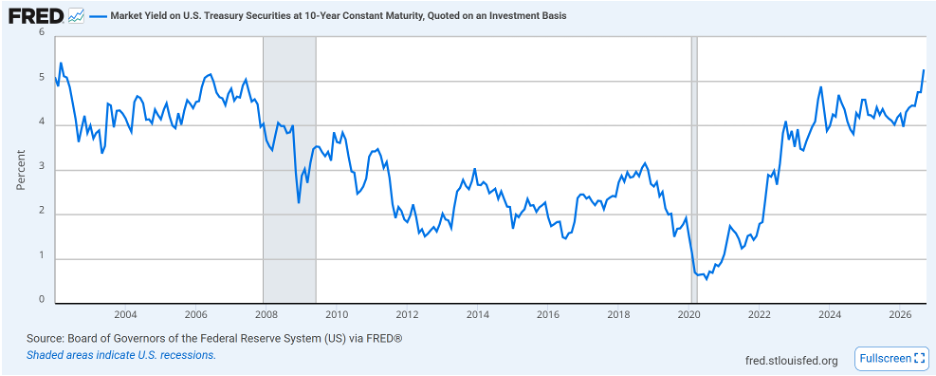
The chart action is particularly noteworthy given that Treasury Secretary Scott Bessent and the U.S. Treasury attempted, unsuccessfully, to avoid this outcome. More specifically, the Treasury “bought back” longer-term bonds and issued bonds with short duration – thereby attempting to provide price support. This first effort at manipulation did not work, and we’ll be looking closely to see if further intervention is attempted.
It’s also noteworthy that we ushered in a new Federal Reserve (“Fed”) Chairman (Kevin Warsh) and the Federal Open Market Committee (“FOMC”) opted to raise interest rates a quarter of a percentage point following their September meeting. This move also should have helped stabilize yields, but it did not. The market is clearly calling for more increases in the Federal Funds Rate.
So, why do we care? Bond yields affect nearly all financial instruments. People, businesses, and governments that borrow money face costs that are directly or indirectly affected by U.S. Treasury yields. Treasury yields impact mortgage rates and housing prices, which is likely top of mind for many readers. Overall, rapidly rising yields can have adverse economic impacts. Moreover, rising yields on bonds make them more attractive as an investment which can (eventually) pull capital away from other investments leading to falling prices elsewhere (most notably, stocks).
General Market Update
US Equities: Remarkably, U.S. equities (largely buoyed by mega-cap tech) are, thus far, unfazed by the rising bond yields. In fact, the S&P 500 Index hit an all-time high during the quarter (August 14) and finished up 2.3%. Despite the skyrocketing 10-year treasury yield over the last month, the S&P 500 finished the quarter only a few percent off its all-time high. However, rising yields are adversely affecting certain sectors of the market. For example, the equal-weighted S&P 500 Index (Ticker: RSP) was down 1.87% in the quarter, driven by poor performance in yield-sensitive sectors including REITs, Utilities, Industrials and Consumer Discretionary which all fell >5% during the quarter. In fact, 7 of 11 sectors were down in the quarter. The divergence is also evident when we contrast the tech-heavy Nasdaq Composite (up 2.5% during the quarter) with the more highly leveraged Russell 2000 small cap index (down 7.5%).
International and Emerging Markets: The Schwab International Equity ETF (SCHF) was down 0.83% for the quarter and the Schwab Emerging Markets ETF (SCHE) was up 0.52%. International markets seem to continue to be beneficiaries as investors rebalance positions in U.S. large cap technology.
Fixed Income and Credit: As mentioned above, the U.S. Treasury “Yield Curve” shifted remarkably higher during the quarter. The 10-year U.S. treasury rose from 4.42% to 5.29% (up 19% - Wow!). As would be expected with that type of move, any income investors holding “duration” (i.e., longer-term positions) generally lost money during the quarter on those positions. We’ve been “overweight” shorter-term bond positions expecting this type of outcome. While it’s difficult to know when long-bonds will stabilize, the current yields are making them increasingly attractive. Moreover, the Fed’s shift toward raising rates could slow or reverse the trend, with implications for both bond and equity portfolios.
Pro-Inflation Investments: Inflation remains well above government targets in many major economies throughout the world. Moreover, federal budget deficits and debt remain at extraordinarily high levels. Lastly, the war in Iran has proven to be highly inflationary given that oil is a price input for nearly all products. Though we would expect some relief later in the year, in our view, inflation remains a key risk and portfolios may benefit from pro-inflationary investments. Precious metals remain among the top investments over a trailing 3-year period along with industrial metals and commodities.
A Look Ahead
It’s an interesting time for markets. Rising (and volatile) bond yields can wreak havoc on economies and markets. Moreover, rising yields can pull capital away from other “risk” assets like equities. The Fed could very well hike rates one more time this year if inflation continues to come in higher than their target. But, the market has proven to be resilient and we tend to think that once inflation pressures ease, interest rates will start to subside. Additionally, any positive news on the Iran war should help ease inflation pressures by allowing the price of oil to decline. Lower interest rates could be a tailwind for risk assets.
The final wild card, of course, is the November midterm elections and any forthcoming policy and budget changes. We are expecting some volatility around the election and will look to rebalance opportunistically around that volatility. But, once the election is behind us we believe the market will be able to focus again on company earnings.
There are certainly risks out there, however, the economy remains resilient with high levels of consumer spending, high output (i.e., gross domestic product) and low unemployment. Moreover, corporate earnings are strong, largely driven by AI-related investment which, for now, does not appear to be slowing down.