
“Time is Your Friend” and other Tips for Young Investors
Recently, we’ve had the pleasure of speaking with some teenagers about investing. We were excited to talk with them about the benefits of long-term investing, and it got us thinking about other young investors. Our experience is that younger investors have perspectives that often vary from our generation – especially given their exposure is limited to what has been a particularly frenetic market environment. The wild price-action of cryptocurrencies, non-fungible tokens (NFTs), “meme” stocks and semi-conductors are contributing to some flawed conclusions. There seems to be a tendency to believe in the opportunity for quick profits and, in some cases, we’re seeing a gambling mentality. Regarding gambling, the problem is exacerbated by the rise of gambling apps on our phones (and now “Prediction Market” apps), which offer stock market “bets” alongside traditional bets. In this article, we strive to cut through the noise and offer some practical lessons to combat these distractions. Please email (or, well … text) it to a young investor in your life.
Warning #1: Investing is Not Gambling
Investing and gambling used to be very distinct activities (e.g., one done through a stockbroker and one limited to the occasional trip to Las Vegas). Modern technology has merged them inside our smartphone apps. Let’s look at Kalshi, for example, which is one of the fastest growing Prediction Market apps. Kalshi allows “bets” on any number of things from sports to politics to economics. While many see the app as a form of harmless entertainment, we find it dangerous in how it conflates gambling and investing. These apps are essentially telling young investors that they’re one and the same. Below is a visual example of a Kalshi prediction bet (known as a “binary option”) asking whether the Nasdaq 100 will hit 33,000 by year end – simply enter a wager amount and swipe right.
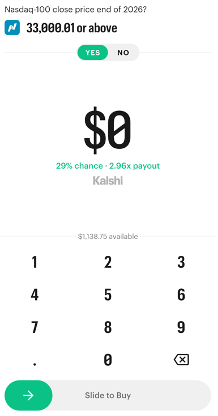
In our view this activity isn’t investing, it’s gambling. Sadly, younger investors are the most rabid users of this new technology, and they may be developing some bad habits – in this case, a short-term investment horizon with an all-or-nothing bet. It’s noteworthy that binary options are a “zero-sum game” where there is a winner and a loser (of equal amounts), while actual investing generally results in positive gains for all participants.
Warning #2: FOMO is Real
Fear of missing out (FOMO) is a well-documented investor behavior that leads to bad investment timing and poor portfolio construction. Many long-term students of the market agree that the market reflects investor emotion – driven, on occasion, to extremes by fear and greed. It’s commonly accepted that the primary engine of parabolic chart moves is human psychology. It is hard, however, to avoid chasing the chart. While cryptocurrencies and NFTs enjoyed well-documented meteoric rises, even exchange-traded stocks saw some blistering moves. Here are some of the more amazing charts from the last fifteen years.
Tesla:
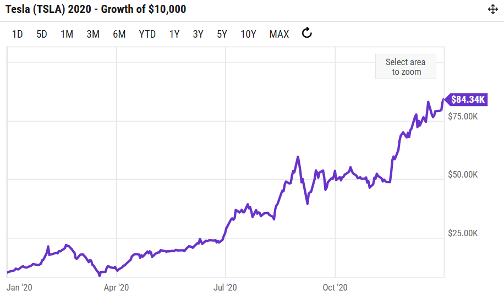
Following its IPO in 2010, Tesla had multiple one-year periods of greater than 5X growth including 2020 (shown below) when it exceeded 8X.
Semi-Conductor Stocks:
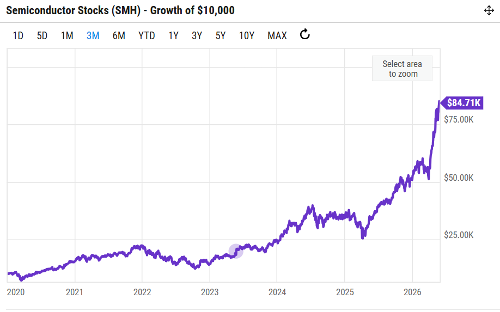
The AI craze recently sent semi-conductor (i.e., microchip) stocks to the moon – up around 2.5X since the start of 2025 and up over 8X since 2020.
GameStop:
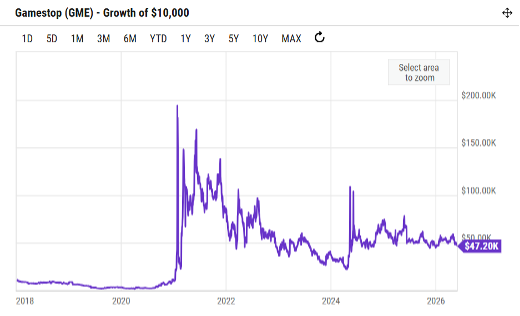
GameStop is arguably the defining moment for retail investing mania in recent history. In January 2021 it exploded higher and, in a period of just a few weeks, reached intraday highs of nearly 100X its starting price.
The net effect of these types of parabolic moves is that it tricks investors into thinking there is a path to easy (or quick) money in the markets. While there are examples of this recently, these are not normal times, and these return charts are unprecedented. Many believe that a prolonged period of zero-percent interest rates combined with budget deficits and federal stimulus are contributing factors to these abnormal moves. Moreover, there are catastrophic declines to complement the gains such as the stablecoin, Terra, which lost most of its value (around $40B) in a matter of days.
Back to the Basics – Investing Heuristics for the Next 100 Years
So, what are the right strategies for success for the young investor? To guide the next 100 years, we would suggest relying on what has consistently worked over the last 100 years. Warren Buffett, one of the world’s greatest investors, is famous for saying “Time is your friend and impatience is your enemy.” He also coined the well-known phrase it’s “Time in the market, not timing the market.” In short, Mr. Buffett knows the three most important facts about market history that are critical to successful investing. That is, (1) equity investments have been the greatest performing investments on earth, (2) the probability of loss is reduced the longer you hold, and (3) compounding of performance is a key driver of long-term returns.
Regarding the first point, the stock market’s historical dominance is well-documented, so we won’t cover it here, but it’s noteworthy that problems (i.e., significant performance deviations) can be created by trying to pick individual stocks or by holding too few stocks. We think passive indices (e.g., SPY and RSP) are a better choice because they are (a) broadly diversified and (b) evolve automatically over time at the discretion of the index provider (i.e., new large stocks are added).
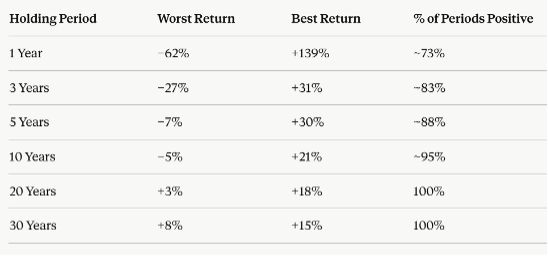
Moving on to investment horizon, the key finding is that investors should hold long-term. The chart below represents S&P 500 Index stocks over the last 100 years. The table below demonstrates that as the holding period lengthens, the range of outcomes narrows, and the probability of loss shrinks. So, young investors should capitalize on this opportunity and invest in equities for the long run – ignoring day-to-day or even year-to-year fluctuations.
Lastly, while we know the stock market is the top performer, don’t ignore the power of compounding (i.e., allowing gains to remain invested). Below is a chart showing the gains of two hypothetical investment strategies on a $10,000 starting balance that earns a 10% return per year. In the first strategy, the 10% gain is withdrawn annually, and in the second, it is reinvested until the end of year 20. As you can see, over a 20-year period, the total return difference is staggering. For someone with 40-50 years of investment time horizon in front of them, this is a powerful tool for wealth building.

A Note on Portfolio Construction
The conversation here has intentionally ignored the concept of “Portfolio Construction” (i.e., building a diversified portfolio of investments to achieve a given objective as outlined in Modern Portfolio Theory). Those concepts are a discussion for another day given that they are less consequential for young investors who should be heavily, if not entirely, invested in the equity market. Moreover, most young investors are building wealth, in part, by consistently contributing to portfolios, which means they mitigate the impact of drawdowns via “dollar-cost averaging” (i.e., as they add they naturally buy more shares when prices are depressed and fewer when elevated).
A Note on Taxes
Our discussion here ignores taxes, but it’s noteworthy that long-term equity investing is also one of the most tax-friendly strategies one can deploy. We’ll save this topic for another day, but we recommend investors start investing by funding accounts such as employer 401(k)s or individual IRAs given the added tax benefits and potential employer incentives (e.g., matching contributions). Once those buckets are filled, a young investor should move on to a taxable brokerage account.
Conclusion
In summary, for the young investor, the strategy for wealth building is obvious and rather simple. That is, get invested as soon as possible to maximize your investment time horizon, try to reinvest all gains to enjoy the power of compounding, and rely heavily on the stock market, which has been the best performing investment over time. Best of luck to all our new young investors out there and, if we can be of assistance, just hit my DM (don’t worry, they’ll know what that means).