
Inflation…Not “Transitory” After All
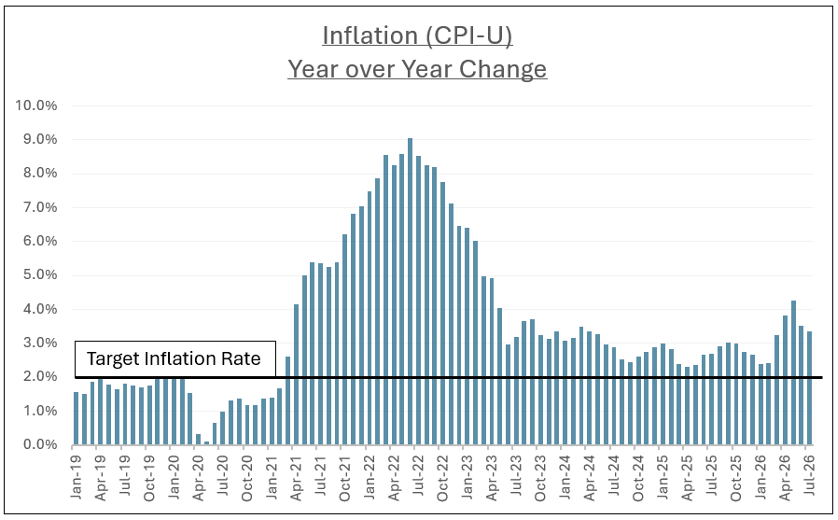
At this point, we’re all feeling the adverse effects of inflation. The post-COVID fiscal policy and clogged supply chains created an inflationary shock that pushed annualized inflation above 8% - a level not seen since the 1980s. Inflation has since fallen from 2022 highs but has remained well above target. Following COVID, we were repeatedly told by the Federal Reserve Bank (“Fed”) Chairman Jerome Powell that inflation would be “transitory.” Not only has inflation failed to be transitory, but there is also no sign that it’s letting up. In this article we review how we got to this point, what may fix the problem and possible implications for investment portfolios.
How bad is it?
As a quick review, most central banks in the world have an inflation “target” of 2%. So, why not 0%? Well, “deflation” (i.e., a negative inflation rate) is generally viewed as extremely dangerous for economies. In other words, if the prices of goods and services are going to be cheaper in the future, people may stop spending, which could lead to economic stagnation. So, a positive rate of inflation (i.e., 2%) has been chosen as a generally accepted target so that falling under the target is still well above 0%. Let’s look at how we’re doing against this 2% target.
The chart below shows the year-over-year inflation rate (as measured by the Consumer Price Index for All Urban Consumers – the CPI-U). The index, published monthly by the Bureau of Labor Statistics, measures a basket of commonly used goods. As the chart shows, we’re failing to achieve the 2% target post COVID – with ABOVE TARGET year-over-year inflation for 65 straight months beginning March 2021. That’s not transitory – that’s an inflation problem.
So, what is causing inflation?
Modeling inflation has proven difficult, but economists generally agree on the following key points related to post-COVID inflation:
1. Post-COVID fiscal policy (i.e., direct consumer stimulus payments) was inflationary.
2. Large budget deficits are inflationary.
3. Wars are inflationary.
But don’t take my word for it, let’s look at the research and see what the experts have to say. For one, there is ample evidence that the post COVID stimulus, such as checks sent directly to consumers and Paycheck Protection Program (PPP) loans, resulted in increased spending and inflation. Below is the Fed’s own conclusion from a post-COVID study.1
“Finally, our results reveal that generous fiscal spending did not significantly contribute to supply expansion: countries with larger fiscal support did not have a significantly different association between mobility and Industrial Production. In other words, supply did not adjust quickly enough to meet the sharp increase in demand for goods.” …
“The previous section highlighted that fiscal support boosted goods consumption demand without any noticeable impact on the supply of goods. Hence, the large increase in demand triggered by the fiscal stimulus policy, together with the slow pace of adjustment in production, likely contributed to the current imbalance in the goods market, resulting in the depletion of inventories, pronounced bottlenecks, and ultimately inflation.”
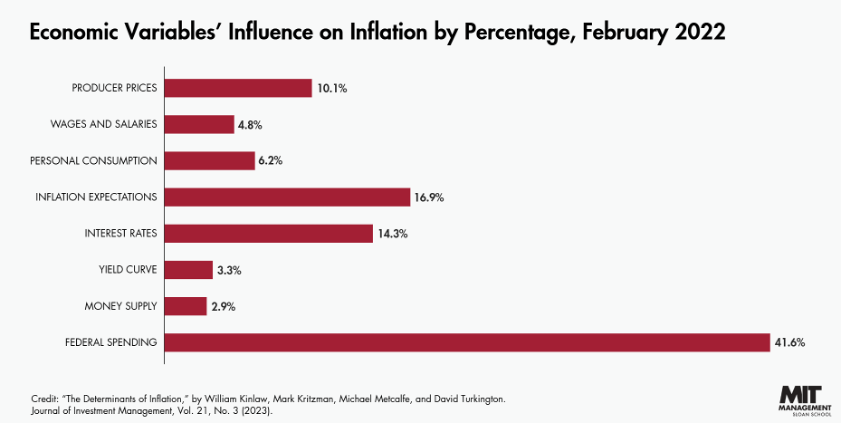
While the Fed concluded that fiscal policy created supply/demand imbalances resulting in inflation, simply running persistent federal budget deficits that increase federal spending is also viewed as inflationary. Below is a chart pulled from an academic research paper from the Journal of Investment Management.2 As one can see, the researchers found many factors that contributed to inflation, but “Fiscal Spending” was, by far, the greatest contributor.
Lastly, regarding the impacts of wars, this topic is rarely debated (i.e., they are deemed inflationary). Wars adversely affect supply chains, typically result in substantial federal budget deficits/monetary debasement and cause supply/demand imbalances in specific industries (e.g., energy and materials used in weapons).
How can the federal government slow down inflation?
The historical (standard) defense against inflation was Monetary Policy (i.e., the Fed’s adjustment of short-term interest rates via changes in the Federal Funds Rate (“FFR”)). For example, Paul Volcker’s raising of the FFR to around 20% in the early 1980s is a classic case study for any economist as inflation dropped double digits from 1980-1983 following this action.
However, economists currently believe that Monetary Policy may have a muted impact on inflation in the modern era in the United States. The thought is that (a) consumers, a key driver of the U.S. economy, are generally not highly leveraged now and (b) the debt held by consumers and business tends to not be variable (i.e., priced off short-term interest rates). In other words, increases in the FFR simply may not curb spending behavior by consumers and businesses in the same way as we’ve seen historically. I guess we’ll find out soon as the Fed began a new raising cycle in September - lifting the FFR ¼ of 1% with further increases projected.
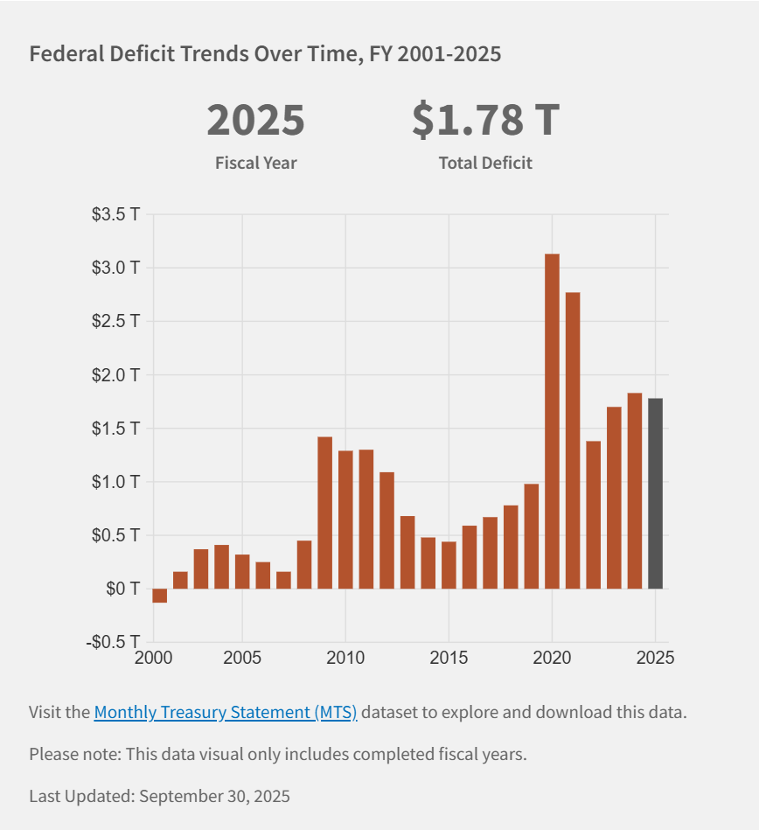
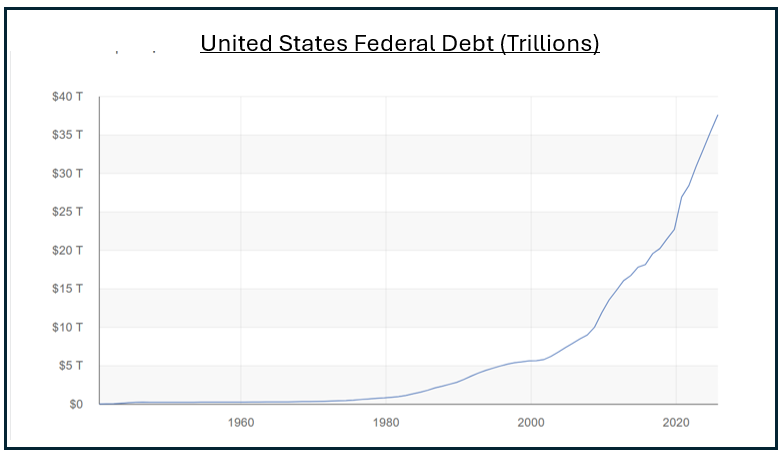
While ending the Iran War would certainly help, most economists now believe that restraining fiscal spending is the likely best, and perhaps only, path to permanently controlling inflation. Count us in this camp as well. The United States Federal Debt recently passed $40 trillion, and we are running budget deficits of over $1.5 trillion per year (around 7% of Gross Domestic Product (“GDP”)). The chart below shows the annual U.S. Federal Budget deficits which show a growing lack of austerity.
Source: https://fiscaldata.treasury.gov/
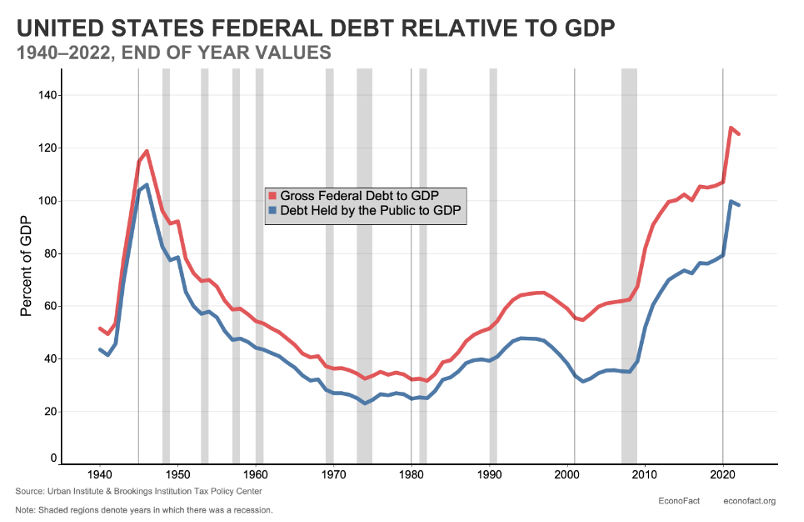
Unfortunately, history suggests inflation may stay elevated long before any fiscal restraint brings it down. Central governments don’t have a history of paying off their debts – rather, they deflate them to a more manageable level. For example, below is a chart that shows U.S. Federal Debt as a percentage of GDP. As one can see from the chart below, we had a similar level of debt to GDP at the end of World War II (e.g., look at the peak around 1945).
Source: https://fiscaldata.treasury.gov/
So, no problem, right? Well, for investors, it’s important to note that we didn’t pay off this debt (e.g., see the chart below which shows a steadily increasing debt level). The key point is that we fixed the ratio of debt to GDP by growing GDP faster than debt through innovation, productivity gains and, most notably, above-average inflation. While AI is likely to help with productivity gains, it’s not likely we can solve this debt issue without above average inflation for a prolonged period.
Source: https://fiscaldata.treasury.gov/
What does this all mean for investors?
Barring a recession OR significant changes in federal spending, we see further inflation on the horizon. As such, we favor holding some inflation “hedges” in portfolios (i.e., investments that benefit from a period of above average inflation). We like a variety of investments for this purpose (e.g., precious metals, industrial metals, land, certain real estate sectors, inflation-protected bonds, variable-rate income tools, and certain equity sectors).
In a highly inflationary environment, it may also be beneficial to reduce exposure to fixed income investments with a long time to maturity (e.g., long-duration bonds). Long-term bonds still have a place in portfolios as a potential hedge against a recession/falling inflation but should generally be held in smaller amounts.
In summary, while the time has come for the U.S. to gain some fiscal austerity, the size of the Federal Debt may prevent any immediate or drastic adjustments. So, given these practical limitations, we see a continued (prolonged) inflationary environment until GDP growth reduces the relative size of the debt as was observed in decades following World War II.
Notes:
1. https://www.federalreserve.gov/, Federal Reserve Bank, Francois de Soyres, Ana Maria Santacreu and Henry Young, “Fiscal Policy and Excess Inflation During Covid-19: a Cross-Country View” (July 2022)
2. https://mitsloan.mit.edu/, Journal of Portfolio Management, William Kinlaw, Mark Kritzman, Michael Metcalfe and David Turkington, “The Determinants of Inflation” (Q3 2023)
This article is for informational and educational purposes only and does not constitute financial advice. The analysis presented here is based on publicly available data and represents a general perspective. All investment decisions should be made with the guidance of a qualified financial professional and based on a thorough understanding of your personal financial situation and risk tolerance. Past performance is not a guarantee of future results. Every investment involves risk and in volatile or uncertain market conditions, significant variations in the value or return on that investment may occur.